

Started: April 12, 2026
Citation: Harvey Sacks, Emanuel A. Schegloff, and Gail Jefferson. A simplest systematics for the organization of turn-taking for conversation. In Language, Vol. 50, No. 4, Part 1, pp. 696-735. 1974.
with no cops... with no master of cermonies to say "your turn next"
Sacks, Schegloff, and Jefferson (henceforth SSJ) present a formal theory of how turns at talk are regulated in situated conversation (maybe more accurately: they present a set of economic principles that describe how opportunities to be heard in conversation are distributed). If we consider these regulations as part of the same system as language,
What is a turn at talk? It is a period of time in which it is in the common ground among conversation participants that a particular speaker (the one who has the turn) currently and exclusively maintains an opportunity to be heard by the rest of the participants.
What does it mean for a speaker to believe they have the opportunity to be heard? If they genuinely believe it's their turn, then they believe (to at least some degree) that their audience expects them to make a contribution (this they believe without a doubt), and that this audience feels they are expected to at least pretend to devote some effort to understanding what may be contributed (thereby making the contribution heard). This is true regardless of whether or not they acquired the turn willfully and proactively (when they take a turn for themselves), by chance (when it feels natural that they are the next speaker), or were explicitly given it by another (whether they want a turn or not).
What does it mean for the audience to believe another has the opportunity to be heard? They believe that the turn-haver believes they are expected to make a contribution; they believe a turn-haver who speaks expects them (the member of audience) to devote some effort to understanding their contribution.
All believe the turn will be terminated according to regulations applied to everyone the same.
In conversations with more than two parties, every individual in the audience of a turn also believes that other coparticipants in the audience believe the same things as them. In such conversations, it's possible that the common-ground expectations, both of contributions and of (perception of) effort at understanding, are different among the pairs of speaker and members of audience; for example, one who bestows a turn to another may expect more strongly contributions of the new turn-haver than the others members of audience, or they may feel they are expected to devote more effort than the others to understanding what the turn-haver might say.
What, then, does it mean to have an opportunity to be heard? From the perspective of the speaker, this is an opportunity (or attempt, welcomed in some sense; or compellence) to (at least appear to, but maybe actually) change the mind of at least one member of your audience. (By "change" of "mind", I don't mean the more colloquial sense of changing one's opinion; I mean a much broader sense that refers to any change of some internal cognitive state, whatever that may be.) From the perspective of the audience, perhaps especially of any member who may be more intimately entangled with the turn-haver (as mentioned in the previous paragraph), this means you are expecting that your mind (at least appear to) be changed in some way or another (we build expectations over how our minds might be changed too; this structure has a special relationship to whatever particular language is in the common ground, and I think is something that SSJ distinguish as irrelevant to their present project).
Although not in all turns -- take, for example, collusion between a speaker and one member of audience to which the other member(s) are not privy (things get much more complicated when there are more than two people around!), to be bound with another by this pairing is to (in some way) consent to a subjection where the turn-haver has the opportunity to exercise conceptual agency over the audience (and sometimes, they put themselves in the position to exercise their agency over their audience; and sometimes, they are compelled by someone else to exercise their agency over their audience). I think this evokes both an intimacy and a vulnerability which we largely fail to appreciate, and ought to be studied alongside of other forms of subjecting relationships, especially ones where the decision to initiate the relationship is done by one party or another. This is the unit of account of SSJ's turn-taking system.
SSJ have nothing to say here about what we do with any particular contribution we make to conversation. Rather, before we investigate this question, we might ought to take one step up and understand instead the general principles governing the most constitutive property of a contribution to situated conversation -- the identity of its speaker; and understand more generally what we do when we have the opportunity to make any contribution to conversation.
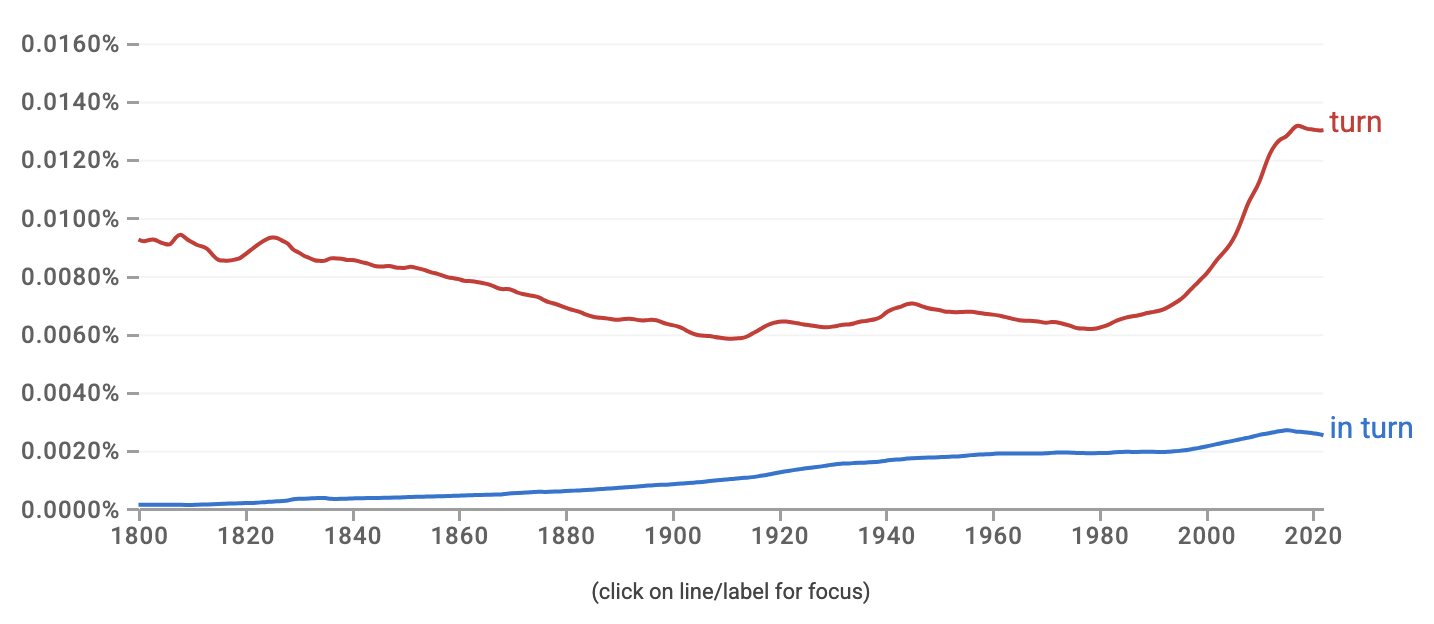
turn-haver --- Curious there is no word for this in English! Is this sense of turn too new? I actually had not interpreted in turn as building on this sense, as it's referred to in Wiktionary. I have the impression that many people use this phrase in a way that disrespects its origin, which implicates some causal relationship between multiple parties. Below is a screenshot from the Google Books Ngram viewer comparing turn and in turn (turn-haver is not in the corpus):
exercise conceptual agency --- I distinguish "conceptual agency" from "agency" in general because turn-at-talk operates in a special type of action space, which I think might be the same space as "speech acts". What exactly this space is, is a question for another day (after I've more thoroughly read Austin); my intuion is that it has something to do with the arbitrariness of the sign (and the dual of this arbitrariness, the ever-present ambiguity and uncertainty in what others mean). The point is that I am imagining a bridge between the currency exchanged in situated conversation and what it might mean to enact speech (to be built on another day).