Something about language is very special, and I'm endlessly curious about what exactly that is, and what we ought to do with whatever we figure out.
One property of language which fascinates me is the ambiguity of the reality of the symbols that comprise it. No symbols are real, but it's often in our best interests to believe they are. This isn't a property unique to language, and there are many questions that arise simply from considering what it means for an individual to imagine a discrete. When it comes to language, the object of study is the relationship between an individual's belief in a symbol and its assumed reality across the many other minds with which the individual may interact. To use language is to engage directly with this object, to make real new atoms and maintain trust in old ones.
I plan to use this space to share my notes on reading some foundational work across a number of fields that probably have some very interesting things to say about these questions. My own background and training is in computing, and to a lesser extent, linguistics. I have become largely disillusioned with where it seems the field of computing has led itself, especially since the early 2020s, where it seems we have abandoned our trust in an interrogable system of symbols, for faith in an artifact that is ultimately comprised of these, though we believe it is not. I've chosen work in linguistics (conversation analysis, pragmatics), dynamic systems, ethnomethodology, science and technology studies, cognitive science (distributed cognition, child development, psycholinguistics, embodiment), human-computer interaction, mathematical logic, economics and game theory, philosophy (of language, politics), ... some of my main inspirations have come from the following papers (surely there will be more added soon):
As an educator (I am faculty at a university in the United States), I take very seriously my duty to help people understand themselves and the world around them. While many in positions of power have recently realized (or at least, recently enacted in a particular way relevant to my expertise) that storytelling and scripture is a convenient and effective way to accrue capital and maintain authority, it is my responsibility and privilege to dissect what is said, to help others empower themselves beyond what these stories prophesize. Part of maintaining a shared trust in a discrete is our ability to understand what we and others mean when we use language. I try to approach what I read and learn with skepticism over whether a symbol presented to me ought to be trusted, and I try to choose the words I use carefully to be ones on which I've actively built trust, or ones where I feel the stakes are low enough that interrogation of trust in that symbol is less important (we don't have enough energy to dissect everything we say, and ultimately, I think we definitionally can't; what's important is to understand where and why we might be taking for granted our trust in a symbol, or whether we are maintaining more of a faith; and whether that practically matters in context).
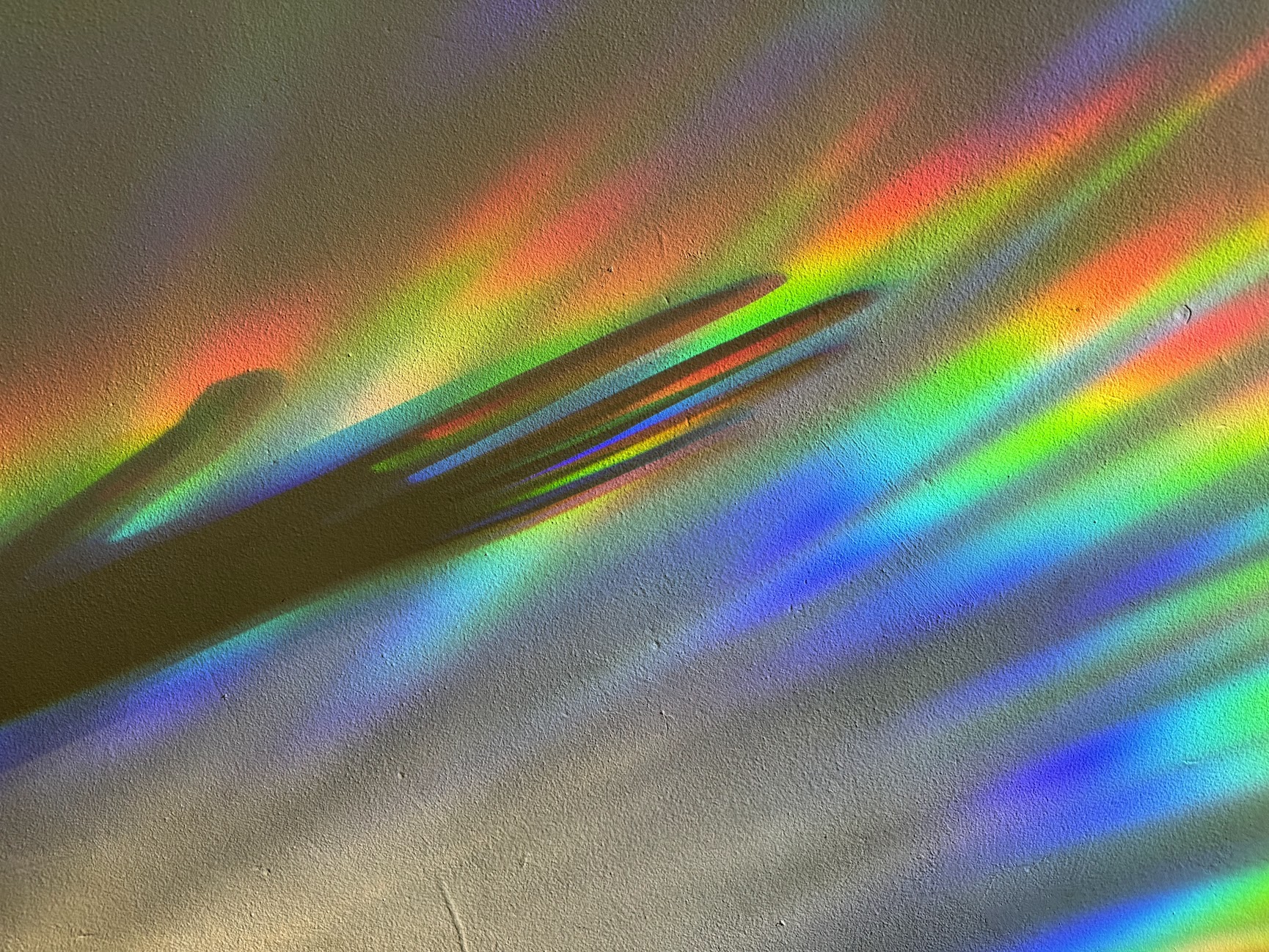
I took the photo above in 2024, when visiting a friend, ER, who lived in Seattle at the time. As of now, I'm not putting a name nor pseudonym on this webpage not because I want to separate myself from what I learn or share, but because I want what I learn from others to be able to stand separate from my identity. Though, there's a good chance you know anyway.
Two disclaimers: this is a living document (so wording and such will be updated when I feel like it should be), and I haven't previously read deeply in most of the areas of the work I am exploring here (so I might make silly claims or say something obvious or naïve or ignoring a whole other history and broader context). Everything is repairable. I aim to be humble, sincere, earnest, naïve, and uncertain. I want to learn more about these areas, so if you have any feedback---questions, suggestions on things I might like to read or obvious things I missed, counterpoints and commentary are all welcome--please fill this form! I would love to hear from you :)